

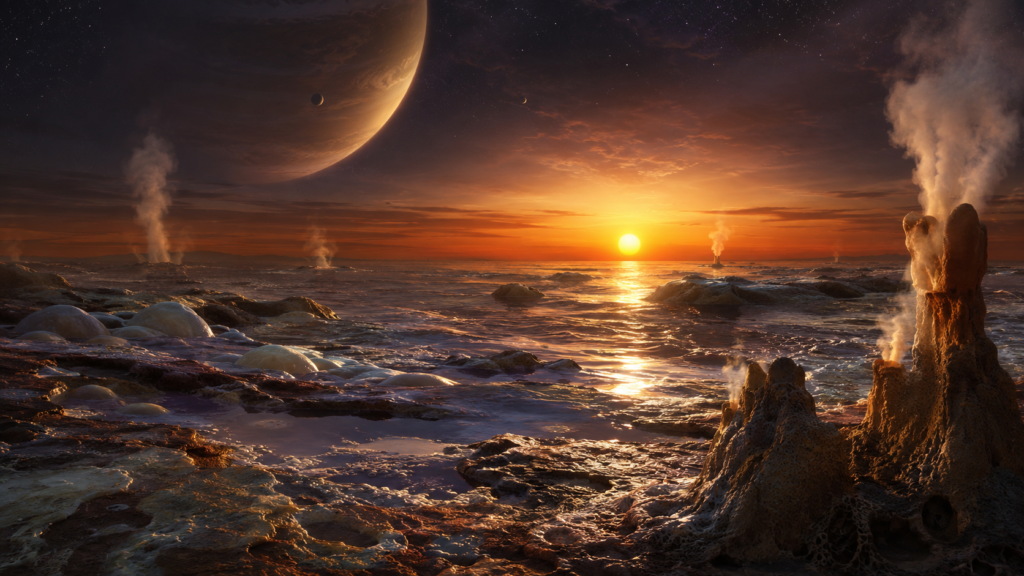
Look up at the night sky and it is difficult not to wonder: are we alone?
Astrobiology turns that ancient question into a scientific investigation. It brings together astronomy, biology, chemistry, geology, planetary science, oceanography, atmospheric science, and even philosophy to explore life as a cosmic phenomenon. Rather than simply imagining extraterrestrials, astrobiologists ask testable questions: How did life begin? What conditions allow it to survive and evolve? Which worlds might support it? What evidence would count as a genuine detection?
No confirmed life beyond Earth has yet been found. That absence is not a dead end. It is the starting point for one of science’s most ambitious searches.
What is astrobiology?
Astrobiology is commonly defined as the study of the origin, evolution, distribution, and future of life in the universe.
That definition contains several connected mysteries:
- Origin: How can non-living chemistry produce systems capable of growth, reproduction, and evolution?
- Evolution: How does life change as it interacts with a planet over billions of years?
- Distribution: Is life unique to Earth, common across the universe, or somewhere in between?
- Future: How long can inhabited worlds remain habitable, and how might life spread or disappear?
Astrobiology is therefore much broader than a search for intelligent aliens. Microbial life, extinct life, and even chemical traces left by ancient organisms would all be transformative discoveries.
What is life?
Before searching for life, we need to decide what we are looking for. This is harder than it sounds.
Living systems on Earth share familiar traits: they use energy, maintain internal organisation, respond to their environment, reproduce, and evolve. Yet exceptions complicate every simple definition. A mule is alive but usually cannot reproduce. A flame uses energy and spreads but does not undergo biological evolution. Viruses evolve, but they depend on host cells to replicate.
One useful working definition describes life as a self-sustaining chemical system capable of Darwinian evolution. It is practical, but it may still reflect our single example of life: Earth.
Astrobiologists must balance two risks. If our definition is too narrow, we might overlook unfamiliar life. If it is too broad, we might mistake ordinary chemistry for biology.
The only biosphere we know
Earth is currently our only confirmed inhabited world, making it both a guide and a limitation.
Life appeared relatively early in Earth’s history, although scientists continue to debate exactly when and how. Over immense spans of time, organisms transformed the planet. Photosynthetic microbes released oxygen, altering the atmosphere and enabling new forms of metabolism. Life diversified from microscopic cells into complex ecosystems, while mass extinctions repeatedly reshaped evolution.
This history teaches us that planets and life co-evolve. Geology, climate, oceans, atmosphere, and biology influence one another. A living planet may not simply host organisms; the organisms may change the planet in ways that can eventually be detected from afar.
The ingredients for habitability
Scientists often begin with life as we know it. That means looking for several broad requirements.
Liquid water
Water is an excellent solvent. It allows molecules to move, interact, and participate in the complex chemistry used by terrestrial organisms. Finding liquid water does not prove that life exists, but it identifies promising environments.
Essential chemistry
Earth life relies heavily on carbon, hydrogen, nitrogen, oxygen, phosphorus, and sulfur. Carbon is especially useful because it can form stable, complex molecules. Astrobiologists search for these elements and for organic molecules, but “organic” does not automatically mean “biological.” Many organic compounds form without life.
A source of energy
Life needs usable energy. Sunlight powers much of Earth’s biosphere, but it is not the only option. Some organisms obtain energy from chemical reactions involving hydrogen, sulfur, iron, methane, and other substances. This makes dark environments, including subsurface oceans and rocks, relevant to the search.
Environmental stability
Life needs enough time and continuity to emerge, survive, and evolve. A world might have water yet lose its atmosphere, experience sterilising radiation, or undergo extreme climate swings. Habitability depends on a system of interacting conditions, not a single checklist item.
Most importantly, habitable does not mean inhabited. A place may possess conditions suitable for life without life ever having begun there.
Extremophiles: Earth’s lesson in possibility
Early ideas about habitability were shaped by environments comfortable for humans. Extremophiles changed that perspective.
On Earth, organisms live in acidic pools, Antarctic ice, hypersaline lakes, dry deserts, deep rocks, and high-pressure ocean trenches. Communities around hydrothermal vents thrive without sunlight, drawing energy from chemistry at the boundary between seawater and rock. Some microbes tolerate intense radiation or remain dormant for long periods.
Extremophiles do not show that life can survive anywhere, and they are not necessarily relics of life’s origin. They do show that the limits of life are much wider than everyday experience suggests. They also help researchers choose terrestrial analogue environments where instruments and life-detection methods can be tested.
Where are we looking?
The modern search ranges from nearby rocks to planets orbiting distant stars.
Mars
Mars once had rivers, lakes, and environments that may have been suitable for microbial life. Today its surface is cold, dry, and exposed to radiation, but the subsurface may preserve ancient organic material or potentially offer protected niches.
Mars missions examine rocks, minerals, chemistry, and geological history. NASA’s Perseverance rover is collecting carefully selected samples for possible future study on Earth. The central question is not only whether Mars is habitable today, but whether it was inhabited when it was warmer and wetter.
Europa
Jupiter’s moon Europa appears to contain a global saltwater ocean beneath an icy shell. Tidal forces generated by Jupiter may supply heat, while interaction between water and rock could provide useful chemistry.
NASA’s Europa Clipper launched on 14 October 2024 and is expected to reach Jupiter in April 2030. It is not designed to detect life directly. Its goal is to investigate whether Europa has environments that could support life by studying the moon’s ice, ocean, composition, geology, and interior.
Enceladus
Saturn’s small moon Enceladus sprays material from its subsurface ocean into space through plumes near its south pole. The Cassini spacecraft detected water, salts, organic compounds, molecular hydrogen, and phosphorus-bearing compounds associated with this ocean environment.
Because plume material can be sampled without landing or drilling through kilometres of ice, Enceladus is a compelling target for future astrobiology missions.
Titan
Saturn’s moon Titan has a thick, organic-rich atmosphere and lakes of liquid methane and ethane on its surface. Its chemistry is profoundly different from Earth’s, while a water ocean may lie deep below.
NASA’s Dragonfly mission is intended to explore Titan’s surface and investigate its complex chemistry, habitability, and the processes that may precede biology. Titan can help scientists study both familiar water-based habitability and more speculative chemical possibilities.
Exoplanets
Thousands of planets have been discovered beyond our Solar System. Some are rocky and orbit within their star’s habitable zone, the range of distances where liquid water could exist on a planet’s surface under suitable atmospheric conditions.
The habitable zone is a useful first filter, not a guarantee. A planet’s atmosphere, mass, magnetic environment, geology, orbit, and host star all matter. Venus and Earth illustrate the problem: they are similar in size, yet their present environments are radically different.
Telescopes can study some exoplanet atmospheres by analysing how light interacts with their gases. Future observatories aim to examine potentially Earth-like worlds in greater detail.
How could we detect life?
Astrobiologists search for biosignatures: substances, structures, or patterns that may be produced by life.
Potential biosignatures include:
- Complex organic molecules or molecular distributions that are difficult to explain geologically
- Cell-like structures, fossils, or distinctive textures in rocks
- Stable-isotope patterns that suggest biological processing
- Atmospheric gases in unusual combinations
- Seasonal or spatial changes consistent with metabolism
- Technological signals, such as artificial radio emissions
Context is everything. Oxygen can be produced by photosynthesis, but it can also accumulate through non-biological processes. Methane can be generated by organisms or geology. A single intriguing molecule is rarely enough.
Researchers therefore look for multiple, independent lines of evidence and test possible false positives. A convincing claim would need to show not only that biology can explain the observation, but that non-biological explanations are inadequate.
Biosignatures and technosignatures
A biosignature is evidence of biological activity. A technosignature is evidence of technology.
The Search for Extraterrestrial Intelligence, or SETI, includes searches for radio or optical signals that might have an artificial origin. Scientists have also discussed looking for atmospheric pollution, unusual heat, large engineered structures, or other planetary-scale effects of technology.
Technosignature research does not assume that advanced civilisations are common. It asks whether observable evidence can be searched for rigorously. Any candidate signal must survive careful checks for interference, natural phenomena, instrumental errors, and human technology.
Why finding nothing still teaches us something
A non-detection is scientifically useful when we understand what was searched, how sensitive the instruments were, and which possibilities were excluded.
If a mission finds that an environment lacks a key ingredient, our models of habitability improve. If a telescope sees no biosignatures in a group of planets, researchers can refine estimates of how frequently detectable life occurs. If SETI searches find no artificial signals, they constrain particular kinds of transmitters over particular distances and frequencies.
“We have not detected it” is not the same as “it does not exist.” Astrobiology advances by steadily reducing the unknown.
Planetary protection
Searching for life creates an ethical and scientific responsibility: we must avoid carrying terrestrial organisms to other worlds and avoid compromising samples brought to Earth.
Forward contamination could damage an extraterrestrial environment or create a false detection. Backward contamination refers to the risk, considered when returning samples, that material from another world could affect Earth’s biosphere.
Planetary-protection practices include spacecraft cleaning, sterilisation standards, careful mission design, sealed sample systems, and secure receiving facilities. These measures protect both science and environments.
The big unanswered questions
Astrobiology is organised around uncertainties that reach from chemistry to civilisation:
- How did life begin on Earth?
- Did life emerge once or multiple times here?
- Which features of Earth were essential, and which were accidents of history?
- Can life use solvents or chemistry very different from ours?
- How common are long-lived habitable environments?
- How often does simple life become complex?
- How can we distinguish a true biosignature from a false positive?
- Does intelligence usually transform a planet in detectable ways?
- How should humanity respond to evidence of life elsewhere?
These questions cannot be answered by one discipline or one mission. They require laboratory experiments, fieldwork, telescopes, spacecraft, computer models, geological records, and open debate.
Why astrobiology matters
Astrobiology changes how we see Earth.
To understand whether another planet is habitable, we must understand climate, oceans, atmospheres, ecosystems, and geological cycles on our own world. To search for distant biospheres, we must learn how life modifies a planet. To prevent contamination elsewhere, we must confront our responsibilities as explorers.
Even before a discovery, the search connects the smallest scales of molecular chemistry with the largest scales of cosmic history. It asks how matter became alive, how life became complex, and whether biology is a rare exception or a natural part of the universe.
We do not yet know whether anything is looking back at us. But for the first time in human history, we possess the tools to turn that possibility into evidence.
That is astrobiology: not an answer, but a disciplined way of asking one of the biggest questions we can imagine.


